
A delivery order (D/O) is an instruction from a carrier or its agent authorizing the terminal, warehouse, or CFS to release cargo to a named party. In ocean freight, it's the document the consignee needs — after surrendering the bill of lading and paying charges — to actually take possession of the goods.
What is a delivery order?
Once a shipment arrives and the consignee has presented the original bill of lading (or telex release) and cleared customs, the carrier issues a delivery order telling the terminal to hand over the containers. Without a valid D/O, the terminal won't release the cargo.
What it includes
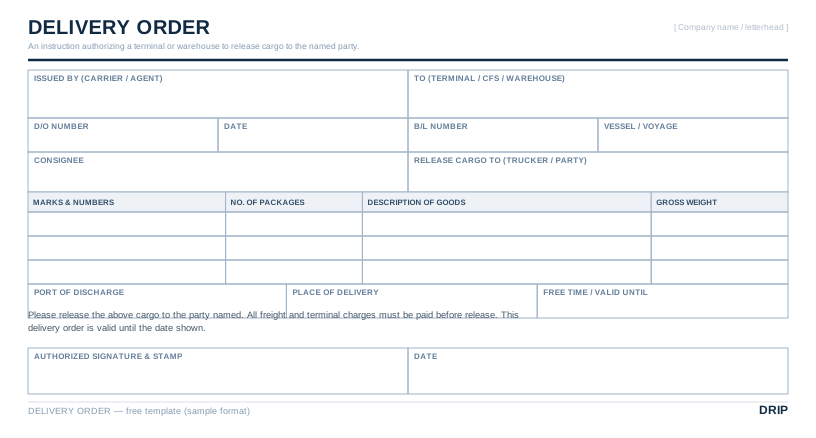
- Issuing carrier/agent and the terminal/warehouse it's addressed to
- D/O number, date, B/L number, and vessel/voyage
- Consignee and the party the cargo is released to (often the trucker)
- Marks and numbers, number of packages, description, and gross weight
- Port of discharge, place of delivery, and free-time / validity date
Free Delivery Order Template
Below is a free, blank delivery order template in the standard format a carrier or agent uses to authorize release of cargo at the port or warehouse. Download the delivery order template
Delivery order vs. bill of lading vs. delivery note
- A bill of lading is the contract of carriage and document of title.
- A delivery order is the carrier's authorization to release the cargo once the B/L is surrendered.
- A delivery note / proof of delivery is signed by the receiver to confirm the goods were actually handed over.
Watch the free time
A D/O usually has a validity or free-time window. Miss it and the cargo racks up demurrage and detention charges, so coordinate your trucker and customs clearance before the D/O is issued.
FAQ
What is a delivery order in shipping? An instruction from a carrier or agent authorizing the terminal or warehouse to release cargo to a named party, issued after the bill of lading is surrendered and charges are paid.
What is the difference between a delivery order and a bill of lading? A bill of lading is the contract of carriage and title document; a delivery order is the carrier’s authorization to release the cargo to the consignee or their trucker.
What information is on a delivery order? The carrier and terminal, D/O and B/L numbers, vessel and voyage, consignee, release party, cargo description and weight, port of discharge, and validity date.
What happens if a delivery order expires? If the free-time window on the D/O lapses, the cargo can incur demurrage and detention charges, so clearance and trucking should be arranged in advance.
Drip Capital gives US businesses fast, collateral-free working capital to buy inventory and bridge long payment terms. See if you qualify →