
Purchase order financing (PO financing) pays your supplier so you can fulfill a confirmed customer order you don't have the cash to fill yourself. The financing company funds the supplier, the goods get made and delivered, and you repay once your customer pays, usually within 30 to 90 days.
It's built for the classic growth trap: a big order lands, your supplier wants a deposit or full payment upfront, and your customer won't pay for another 60 or 90 days. Turning the order down costs you the sale. Paying for it out of operating cash can leave you short on payroll.
This guide covers how PO financing works, what it really costs, with a calculator to check your margin on any order, and how to choose a provider.
✓ Funds in 24–48 hours, paid directly to your supplier
✓ Repay in 30–90 days, once your goods sell or your customer pays
✓ No collateral required
What is Purchase Order Financing?
Purchase order financing is short-term funding secured by a confirmed customer purchase order. Instead of lending against your balance sheet, the provider looks at the order itself: who the customer is, whether the supplier can deliver, and whether the margin covers the cost.
The provider typically pays your supplier directly, covering part or all of the supplier's cost. That can be a deposit, the full order or the balance due before shipping. Once the goods are delivered and your customer pays, the provider takes its fees and the rest is yours.
A purchase order is a commercial commitment from your buyer, which is why it can support financing. Terms on risk vary: some providers absorb the loss if your customer fails to pay (non-recourse), but many PO financing agreements are full recourse, meaning you're still responsible. Always check which applies.
PO financing is common in import and export financing, where supplier payments and customer collections are separated by weeks of production and transit. Funds are usually outstanding for 30 to 90 days, often around 45.
How Does Purchase Order Financing Work?


- You receive a confirmed order from a creditworthy customer, larger than your cash can cover.
- You apply, sharing the customer's purchase order, your supplier's quote or pro forma invoice, and basic financials.
- The provider checks the deal: your customer's credit, your supplier's track record and your margin on the order.
- Your supplier gets paid directly, for the deposit, the full amount or the balance before shipping.
- The goods are produced and shipped to your customer.
- Your customer pays on its normal terms.
- The financing is settled: the provider deducts its fees and releases the balance to you.
A real example: a wholesale distributor receives a $200,000 purchase order from a retail chain. Its supplier requires payment upfront, which the distributor can't cover from operating cash. A financing company pays the supplier $170,000 directly. The goods are made and shipped, and the retail chain pays the full $200,000 45 days later. The financing company deducts a 3% fee ($6,000) and sends the remaining $24,000 to the distributor. The distributor fills a $200,000 order with no upfront cash.
What about supplier deposits? Overseas suppliers rarely want one payment. These are the payment terms US importers describe to our team most often:
- "The overseas factory wants 30% upfront and 70% at vessel loading."
- "Our suppliers in China generally require 100% advance payment."
- "We pay a 20–30% deposit, then the balance before goods arrive, with over a month on the water."
A good PO financing setup can pay the deposit, the balance or both, so the cash you'd have tied up for the whole production-plus-transit cycle stays in the business.
Purchase Order Financing Costs
PO financing is usually priced as a fee per 30 days on the amount financed. Costs depend on the order size, how long the money is out, your customer's credit and your supplier's reliability.
- Monthly rate: specialist PO financing companies typically charge about 1.8% to 6% per 30 days.
- Rate steps: some providers charge more as the order ages, for example 2% for the first 30 days, then an extra 0.5% every 15 days.
- Annualized cost: on a full-year basis, these fees work out to roughly 20% to 75% APR. Because most orders are repaid in 30 to 90 days, though, the cost per order is usually a few percent of the amount financed.
- Other fees: setup, due diligence, wire or late-payment charges may apply.
Compare purchase order financing rates
| Funding option | Typical cost | Who gets paid | Best for |
|---|---|---|---|
| PO financing company | About 1.8%–6% per 30 days | Your supplier, directly | Large confirmed orders you can't fund yourself |
| Invoice factoring | About 1%–5% per month | You, against an issued invoice | Getting paid sooner after delivery |
| Bank line of credit | Prime Rate plus a margin; lowest cost | You, up to your limit | Businesses with collateral and time to qualify |
| Merchant cash advance | Factor rates that are often far more expensive | You, repaid from daily or weekly sales | Rarely the right fit for supplier payments |
| Drip Capital supplier funding | Priced per business at approval; no collateral | Your supplier, directly | Importers and distributors paying suppliers before customers pay |
Rule of thumb: your gross margin on the order should be at least 15% to 20% after financing fees, or the order may not be worth taking on. Check any order with the calculator below:
Pros and Cons of Purchase Order Financing
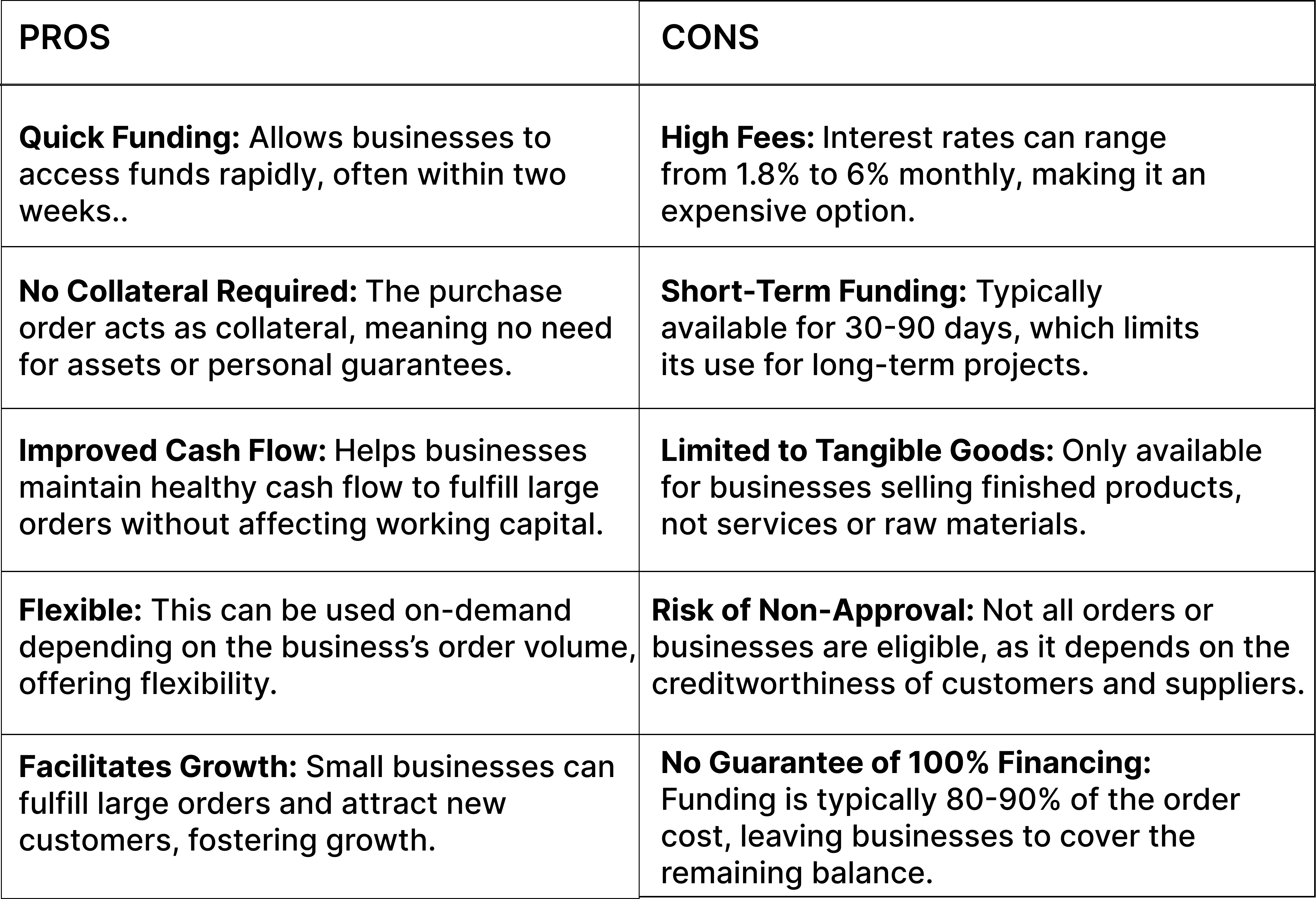
Pros: you can accept orders larger than your cash, it's approved mostly on your customer's credit, there's no long-term debt, and suppliers get paid on time, which can earn you better pricing.
Cons: it costs more than a bank loan, works only for physical goods, needs a creditworthy customer, and adds a third party to your supplier payments. Recourse terms may leave you responsible if your customer doesn't pay.
Who Should Consider Purchase Order Financing?
PO financing works best for businesses that sell physical, finished goods to other businesses or government buyers, and that regularly pay suppliers long before customers pay them.
- Importers and distributors: paying overseas factories while goods spend weeks on the water.
- Wholesale and retail suppliers: filling big-box or chain-store orders that pay on net 60 to 90.
- Manufacturers: buying raw materials and components for a large production run.
- Consumer brands: funding seasonal inventory builds and product launches.
- Government contractors: fulfilling agency orders. See government PO financing.
Situations US business owners describe to our team:
- "We have open orders we can't fulfill because suppliers want advance payment. Cash shortages cause stockouts and lost revenue."
- "Suppliers want prepayment, our large customer pays in 70–90 days, and we don't want cash blocked for that whole cycle."
- "Orders are ramping fast. We must pay factories upfront while big OEM customers pay on net 90."
- "Can you advance funds to our overseas supplier so we can secure better pricing for paying upfront?"
That last point matters: paying suppliers faster can earn an early-payment discount that offsets part of the financing cost.
Not a fit: service businesses with no goods to finance, orders with thin margins (under about 10%), or customers with weak credit.
Purchase Order Financing vs Invoice Factoring

These two products are often confused. They solve related problems at different stages of the order.
Purchase order financing is pre-fulfillment. You have the order, but you need cash to pay your supplier before you can ship.
Invoice factoring is post-fulfillment. The goods have shipped and you've issued an invoice. The factor advances a percentage of it while you wait for payment.
| Purchase Order Financing | Invoice Factoring | |
|---|---|---|
| When it applies | Before goods are delivered | After goods are delivered |
| Backed by | Confirmed purchase order | Issued invoice |
| Who gets paid | Your supplier, on your behalf | Your business (advance on receivable) |
| Typical cost | About 1.8%–6% per 30 days | About 1%–5% per month |
Many businesses use both in sequence: PO financing to fill the order, then invoice factoring or receivables financing to collect faster once the invoice is issued. For a deeper comparison, see PO financing vs invoice financing and PO financing vs a working capital loan.
How to Get Purchase Order Financing
- Check the order qualifies: a confirmed order for physical goods from a creditworthy buyer, with a healthy margin. See who qualifies for PO financing.
- Gather documents: the customer's purchase order, your supplier's quote or pro forma invoice, recent financial statements and bank statements. A clean purchase order template helps.
- Compare providers on total cost for this order, using the calculator above, not just the headline rate.
- Apply and get approved: the provider reviews your customer, supplier and margin.
- Your supplier is paid, directly by the provider.
- Deliver and get paid: your customer pays, the provider settles its fees, and you receive the balance.
How to Select a Purchase Order Financing Company
- Order size fit: can it fund your typical order, and your biggest one?
- Total cost: compare the all-in cost on a real order, including rate steps and fees, not just the monthly rate.
- Supplier payments: can it pay overseas suppliers, deposits and balances, in the way your suppliers actually invoice?
- Recourse: who carries the risk if your customer pays late or not at all?
- Speed: how fast is the first approval, and how fast are repeat orders?
- Supplier experience: will the provider handle your supplier professionally? Prospects often ask us whether adding a financing company will affect vendor relationships.
- Range of products: a provider that also offers vendor financing and receivables financing can support the whole cycle, not just one order.
How Drip Capital Funds Purchase Orders

Drip Capital pays your suppliers directly, in the US or overseas, so you can place bigger orders without draining operating cash:
- Funding up to $3M
- Funds in 24–48 hours
- Repayment in 30–90 days
- No collateral required
It's built for importers, wholesalers, distributors and manufacturers paying suppliers before their own customers pay. Selling into or sourcing from other countries? See international purchase order financing.
From a Drip customer: an apparel importer from California buys men's shirts from overseas manufacturers and sells them to US retailers. Drip has financed 145 invoices for them since 2024, including $1.5M advanced against inventory in transit. Drip pays the manufacturer, and the importer repays once the retailer pays on its terms.
"Every shipment brings the same timing problem: pay the manufacturer now, get paid by the retailer later. Drip Capital financed that gap on every single one, so we never had to slow down between shipments." Founder, apparel importer from California
Check your eligibility or call +1 (650) 437-0150 to talk to our team.
Frequently Asked Questions
What is purchase order financing?
Purchase order financing is short-term funding that pays your supplier so you can fulfill a confirmed customer order you couldn't otherwise afford to fill. You repay the financing company once your customer pays, typically within 30 to 90 days.
How does purchase order financing work?
You receive a purchase order from a creditworthy customer, apply with the order and your supplier's invoice, and the financing company pays your supplier directly. The supplier produces and ships the goods, your customer pays on its terms, and the financing is repaid from that payment, minus the provider's fees.
What are typical purchase order financing rates?
Specialist PO financing companies typically charge about 1.8% to 6% per 30 days, which works out to roughly 22% to 73% a year if the order stays open for twelve months. Because most orders are repaid in 30 to 90 days, the real cost per order is usually a few percent of the amount financed. Compare offers on the same order with the calculator in this guide.
Can I get a loan on a purchase order?
Yes. Purchase order financing is effectively a loan secured by a confirmed order: the provider funds your supplier because your customer has committed to buy. Approval depends mainly on your customer's credit, your supplier's ability to deliver and your margin on the order.
What is a funded purchase order?
A funded purchase order is a customer order for which financing has already been arranged, so the supplier can be paid and production can start. It lets a business accept orders that are larger than its available cash.
Is purchase order financing the same as invoice factoring?
No. Purchase order financing pays your supplier before goods are delivered so you can fulfill the order. Invoice factoring advances cash against invoices you have already issued after delivery. Many businesses use PO financing to fill an order, then factoring to get paid sooner on the resulting invoice.
Can I get purchase order financing with bad credit?
Often, yes. PO financing companies focus mostly on your customer's creditworthiness and your supplier's reliability, so a business with limited or weaker credit can still qualify if the order is solid and the margin covers the financing cost.
Can purchase order financing pay a supplier in China?
Yes. Many providers, including Drip Capital, can pay overseas suppliers directly, including in China and the rest of Asia. That's useful when factories ask for a deposit upfront and the balance before goods are loaded.
How long does purchase order financing take?
With documents ready, most providers approve and fund within a few business days. Repeat orders with an existing provider move faster. With Drip Capital, approved supplier payments are funded within 24–48 hours.
Who qualifies for purchase order financing?
Businesses that sell physical goods to creditworthy business or government customers usually qualify. The order should be confirmed and not yet delivered, the supplier should be reliable, and your gross margin should comfortably cover the financing cost, ideally 15% to 20% or more after fees.
Related guides: What is purchase order financing? · Funding against a purchase order · How to fulfill a large purchase order · PO financing for startups · Government PO financing · Supply chain finance